
A New Approach to UAS Intelligence: How the AIE and ATLS Turn Fragmented Data into Mission-Ready Insights
How Lazarus AI is changing the way operators are thinking about field-level UA intelligence in real-time and on the ground.

In defense and dual-use markets, the volume of unmanned aerial systems (UAS) intelligence has grown, but the ability to act on it has become exponentially more difficult. Specifications, ownership records, supply chain disclosures, threat reporting, and open-source signals live across disconnected databases, government portals, and proprietary feeds and systems. A warfighter in the field or program officer trying to assemble a complete picture of a single device (its origins, components, known vulnerabilities) often spends hours manually cross-referencing. When it really matters, those crucial hours mean lives at risk and failed missions. Operators in high-stakes environments need near-realtime information, not information in hours or even minutes.
While this seems like a problem perfectly suited for agentic AI and orchestration systems, it also feels like a problem susceptible to the AI Production Gap we’ve discussed previously, particularly when it comes down to field-level operational use. The question isn't whether a model can summarize a drone spec sheet or analyze pictures. Rather, the question is whether an entire UAS intelligence workflow can run reliably, securely, and fast enough to matter when making decisions. Deploying ATLS for UAS Intelligence is built to close that gap.
The Cost of Getting This Wrong Is Rising
The $2.4 billion defense UAV market depends on information that is technically available across data lakes but inaccessible in practice. Warfighters often lose hours per query. Industry partners struggle to demonstrate credibility to government buyers because there is no single venue where their presence and provenance are verified. Decision-makers approve procurement without real-time visibility into foreign ownership exposure, adversary-sourced components, or disinformation surrounding a given platform.
Federal procurement rules have hardened around exactly these concerns. The FAR 52.240-1 Prohibition on Unmanned Aircraft Systems Manufactured or Assembled by American Security Drone Act-Covered Foreign Entities now restricts federal acquisition of unmanned systems tied to covered foreign entities, the FY2026 National Defense Authorization Act expanded counter-UAS funding and drone procurement priorities, and a December 2025 Federal Communications Commission ruling blocked new authorizations for foreign-made UAS and certain components. The cost of getting the answer wrong is rising in step with regulatory pressure.
The consequences extend past delay. Duplicated procurement, compromised missions, and supply chain vulnerabilities surface only after fielding a system. What looks like a workflow problem is in fact a security posture problem.
Why This Hasn't Been Solved Yet
Two categories of vendors have attempted to overcome this challenge, and neither has closed it.
The big model labs argue that a sufficiently capable model is the answer. OpenAI, Anthropic, and Google are training systems that can reason about almost anything in natural language, including UAS specifications. However, a single model call or a closed-system agentic approach is not equal to an intelligence-grade workflow. Answering a real procurement question requires data retrieval from disparate sources, cross-referenced against sanctions and ownership data, verification against open-source reporting, and a traceable audit trail at every step. Foundation models do not produce that on their own, and "just use a smarter model" does not survive contact with a regulated procurement process. The hard problem is multi-system, multi-model, multi-tool orchestration, not generation.
The integration giants are arguing the opposite. Defense data problems, in their telling, require multi-year platform deployments, forward-deployed engineering teams, and deep customization. For some problems, the heavy approach works. For UAS intelligence, specifically, it does not. Operators can’t wait 18 months for a custom Foundry build to come online. They need something that sprints into the field in weeks, runs on open infrastructure, and can be tactically tuned to their environment rather than forcing the environment to bend to the tool. The platform-first approach assumes the customer can absorb the deployment cost. Most cannot, and most should not have to.
The Lazarus AIE approach with our ATLS orchestration system sits between these two approaches. It treats the foundation model as one component in a workflow rather than the workflow itself. It assumes the deployment has to be configured to the environment rather than the other way around. And it commits to the discipline that closes the production gap: problem engineering, prompt engineering, and context engineering, run together inside an orchestration layer that auditors and regulators can read.
ATLS for UAS Intelligence
ATLS is the orchestration layer of Lazarus AI's Applied Intelligence Engine, the part of the system responsible for executing complex, multi-source intelligence work reliably. ATLS for Drone Intelligence applies that orchestration to UAV-specific data, continuously ingesting open-source intelligence, government databases, and industry sources into a unified interface that operators can query in plain English.
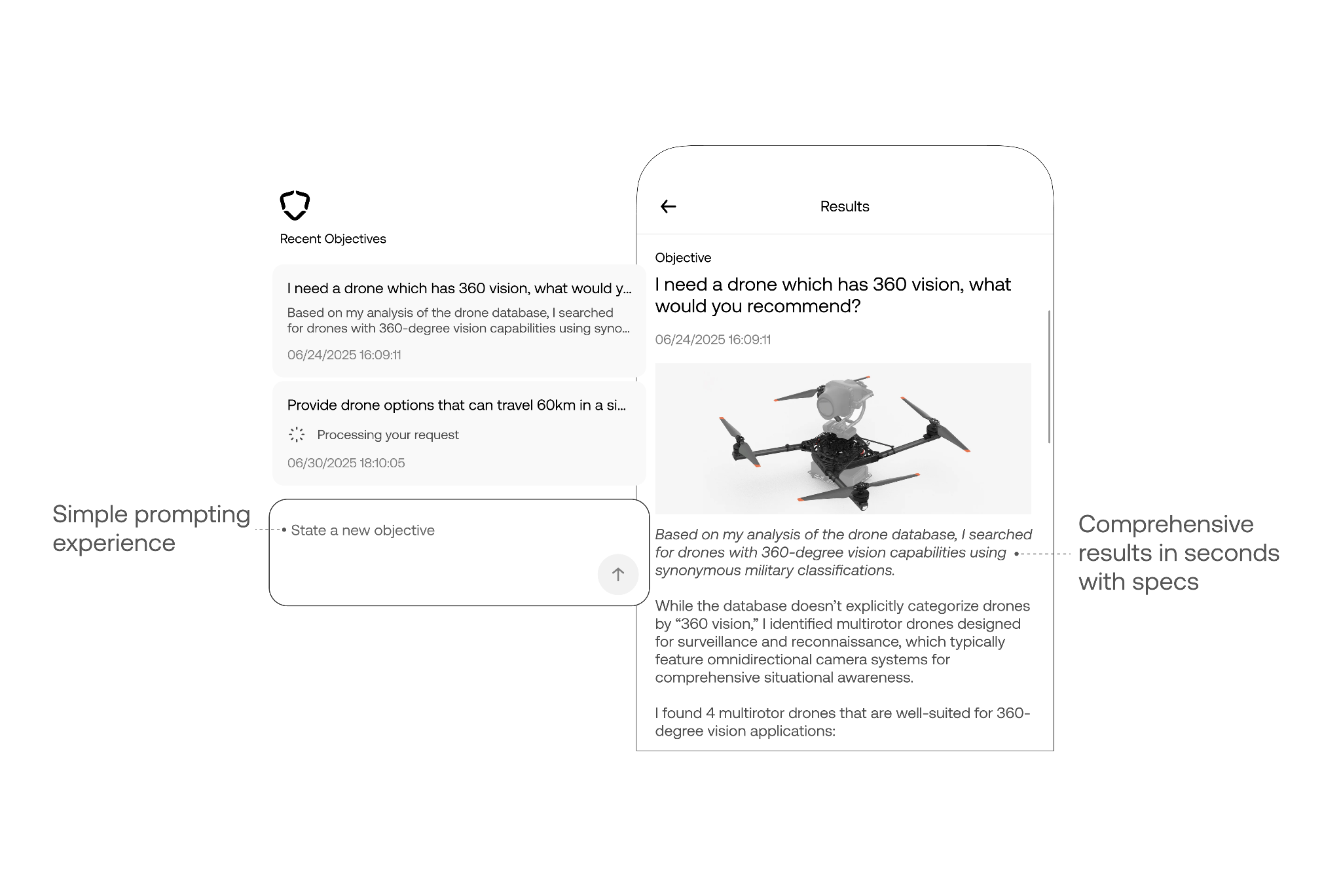
The platform reflects three operational principles Lazarus brings to every production deployment.
Execution focused, model-independent. Answering a question like "what type of drones should be used for training to maintain operator skills using swarm capabilities?" or "what conditions do drones with high payload capabilities face challenges in?" are not a single-model call and not well-suited for a single-model strategy. It is a sequence of retrieval, verification, cross-reference, and risk scoring that must run the same way every time. ATLS drives that orchestration so the user experiences a single, near real-time response instead of a chain of tools they have to drive themselves.
Configurable to the deployment. Defense and commercial users have different access requirements, data sensitivities, and workflows. Lazarus can tune ATLS to the operating environment rather than retrofitting around a rigid set of products and tools.
Modular, portable, measurable. ATLS deploys on cloud-native, open-source infrastructure, which means it can be fielded rapidly, and it can be iterated on as threats evolve. Every step in an answer is traceable, which matters in regulated environments where "the model said so" is not an acceptable audit trail.
Built-In Risk Intelligence
Beyond consolidation, ATLS can point out risks automatically, flag disinformation circulating about a given platform, identify supply chain dependencies on adversary nations, analyze foreign ownership structures, and highlight components that introduce sanctioned or compromised suppliers into a program. Security context arrives alongside the spec sheet rather than after a separate investigation.
Timing changes the value of information. Intelligence that informs a procurement decision is worth more than intelligence that arrives weeks after one has been made.
From the Operations Center to the Edge
The clearest test of whether a system works is whether it works where the decision is made in the field, or at higher levels of command.
Until recently, an operator in the field with a question about a UAS had limited options. Route the question to an analyst at an operations center, wait for that analyst to navigate a myriad of disconnected systems, and accept the latency that came with the round trip, or make the decision without the answer.
ATLS changes the geometry of that challenge. The same orchestration that runs in a program office can run at the tactical edge, on infrastructure the operator has readily available. The question goes in, and the cross-referenced, risk-scored answer returns in plain English, with the supply chain context, ownership exposure, and open-source flags attached. The decision at the tactical edge with readily available analytical insight.
Measurable Impact
For defense organizations, ATLS for UAS Intelligence compresses research time from hours to minutes, gives early warning on supply chain risks before they enter the procurement pipeline, and reduces the downstream cost of fielding systems with hidden foreign exposure.
For industry partners, the platform provides verified market presence that accelerates credibility with government buyers, real-time visibility into emerging requirements that supports business development, and transparent display of ownership and component sourcing that simplifies due diligence on both sides of a partnership.
The mechanism is the same in both cases. Manual cross-referencing is replaced by orchestrated execution, which produces consistent and auditable answers.
A Single Trusted Source That Scales
The Lazarus AIE and ATLS for UAS Intelligence is a trusted platform for government and commercial UAV stakeholders. Its architecture is built for expansion into adjacent enterprise data integrations, deeper analytical capabilities for program offices and primes, and allied-nation partnerships where shared intelligence accelerates coalition operations.
UAS intelligence is one domain where the AI Production Gap is unusually visible but not unique. Any regulated, high-stakes environment where information is decentralized and the cost of a wrong answer is real needs the same orchestration discipline. That is what ATLS provides.
Talk to us about how ATLS can be deployed against your most fragmented intelligence workflows in defense, in regulated industry, and across allied programs. Get started.