
Constructor: Mainframe Modernization Starts with Understanding, Not Translation
Why successful modernization starts with understanding your system—not simply translating its code.

For decades, organizations have treated mainframe modernization as a technology problem.
How do we move from COBOL to Java? How quickly can we replace legacy applications? How much of the process can we automate?
Those are important questions. They're just not the first ones that should be asked.
The greatest obstacle to modernization isn't translating COBOL. It's recovering the decades of institutional knowledge hidden inside applications that have evolved far beyond their original design. Documentation becomes outdated. Engineers retire. Business logic accumulates through years of enhancements until the production system becomes the only reliable source of truth.
This disconnect (often called asset drift) is one of the biggest reasons modernization projects become expensive, risky, and unpredictable. Organizations aren't just modernizing legacy code. They're modernizing systems they no longer fully understand.
Why Translation Isn't Enough
Most modernization approaches focus on converting code from one language to another.
Manual rewrites require years of engineering effort and depend on expertise that may no longer exist. Line-by-line conversion often preserves COBOL's procedural structure inside Java, producing applications that work but remain difficult to maintain. Runtime wrapper solutions introduce long-term vendor dependencies, while generic AI code generation still leaves organizations with the challenge of proving that the new application behaves exactly like the original.
Even when the translation itself is functionally correct, another challenge emerges after deployment. Without a documented link between the new application and the original business logic, every production issue becomes an investigation and every future enhancement becomes archaeology. Speed at the moment of conversion does little to help six months later when something breaks and no one can trace why.
Each approach solves part of the problem, but none solves the knowledge gap that exists before modernization begins or preserves that knowledge after the migration is complete.
Constructor Approaches Modernization Differently
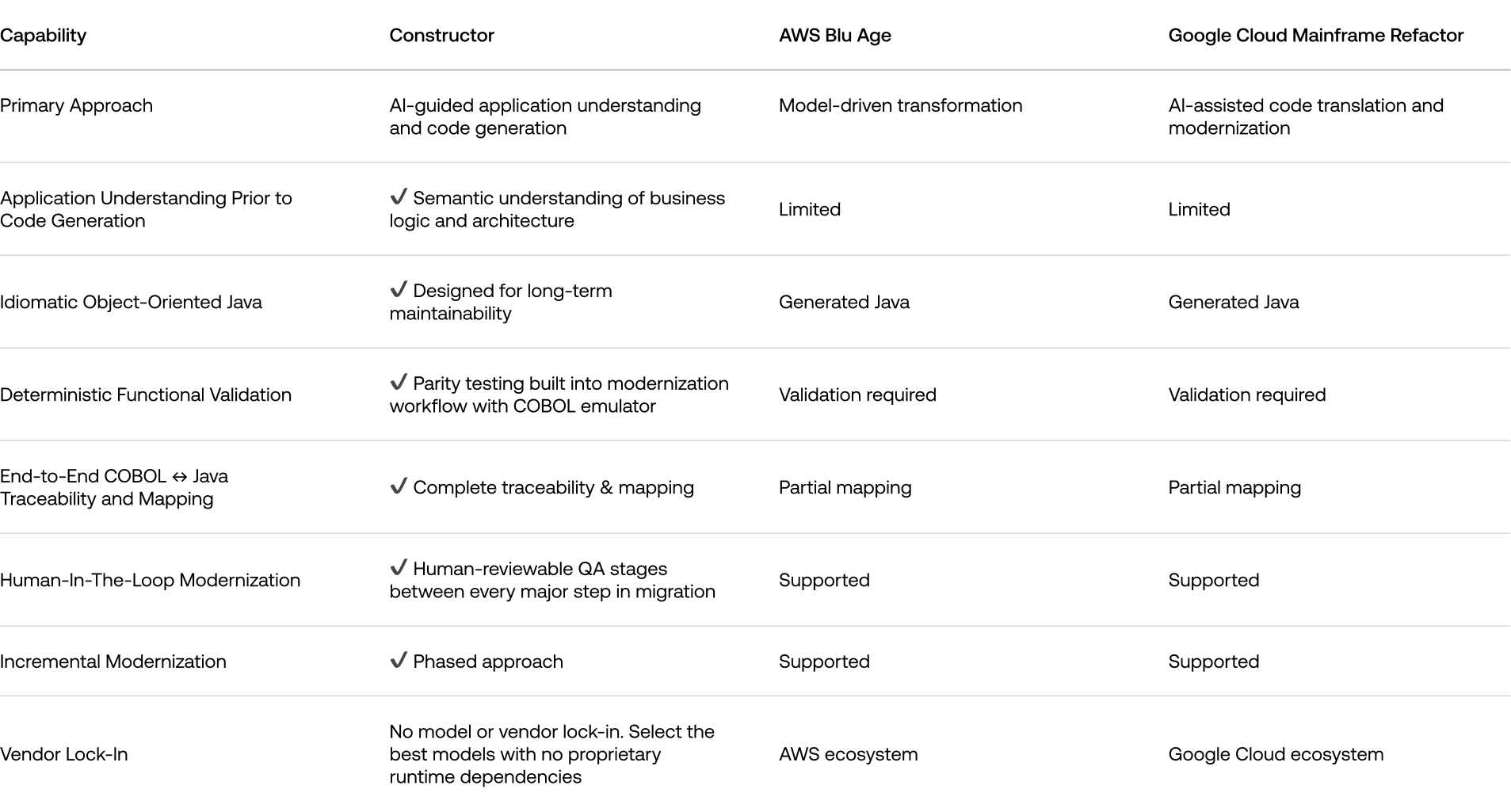
Before generating modern code, Constructor analyzes what's actually running on the mainframe and reconstructs how the application works. It produces a comprehensive design specification, architecture diagrams, and migration documentation that describe the system in natural language, giving engineering teams an accurate, reviewable understanding of the application before any code is converted.
That visibility changes the modernization process entirely.
Instead of discovering ambiguities halfway through a migration, organizations identify and resolve them at the outset. Engineers can validate business rules, clarify edge cases, and review the migration approach before development begins. Given how often organizations no longer fully understand their own COBOL applications, bringing stakeholders into those gray areas early isn't simply a planning exercise—it's where some of the biggest modernization risks are identified and addressed before they become production issues.
Modernization becomes an informed engineering exercise rather than an expensive discovery process.
From Knowledge to Modern Software
Understanding the application is what makes better modernization possible.
COBOL and Java organize software in fundamentally different ways. A literal translation often produces what's sometimes called JOBOL (Java syntax wrapped around COBOL architecture). It compiles, but it doesn't take advantage of modern software design.
Constructor generates code from its reconstructed understanding of the application rather than directly from COBOL syntax. This allows it to produce idiomatic Java that preserves business behavior while following modern engineering practices. It can also adapt the generated code to customer-specific Java style guides, making the application feel native to the teams responsible for maintaining it.
Confidence Through Evidence
Organizations also need confidence that any new application behaves exactly like the old one.
Constructor validates this confidence through comprehensive testing, deterministic validation, and end-to-end traceability. A built-in COBOL emulator exercises the original application before modernization, then compares the generated Java against the same test scenarios to verify behavioral parity.
Just as importantly, Constructor produces detailed documentation and traceability that map every Java component back to its COBOL origins. When production issues arise or new features need to be added, engineering teams can quickly trace business logic to its source instead of rediscovering it from scratch. That documentation doesn't just support the migration, it continues to create value throughout the application's lifecycle.
A Better Way to Modernize
Mainframe modernization has traditionally been measured by speed, i.e. how quickly code can be converted and how much manual effort can be eliminated.
Those metrics still matter, but they no longer define success.
Successful modernization is about creating applications that organizations can confidently own, maintain, and extend for decades to come. That requires more than automation. It requires understanding, validation, and documentation that preserve institutional knowledge long after the migration is complete.